❌

Normale Ansicht

Apple Executive in Charge of iPhone's Camera App Reportedly Retires

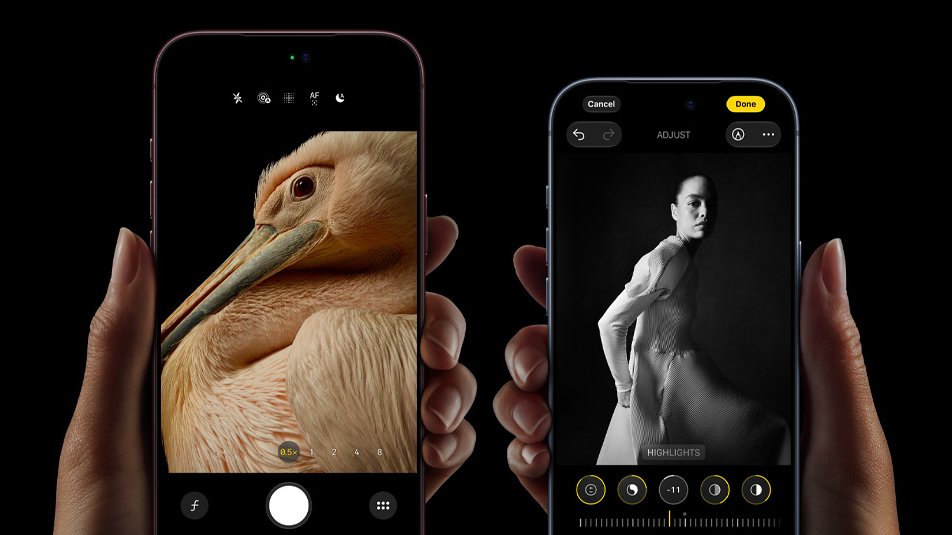
Apple's vice president of camera and photo software engineering Jon McCormack retired at the end of October after more than eight years at the company, according to Bloomberg's Mark Gurman. The report said he oversaw the iPhone's Camera and Photos apps and their underlying technologies, so his departure is notable.
This article, "Apple Executive in Charge of iPhone's Camera App Reportedly Retires" first appeared on MacRumors.com

Discuss this article in our forums

  •  

MacPaw's Moonlock Cybersecurity App Launches for iPhone

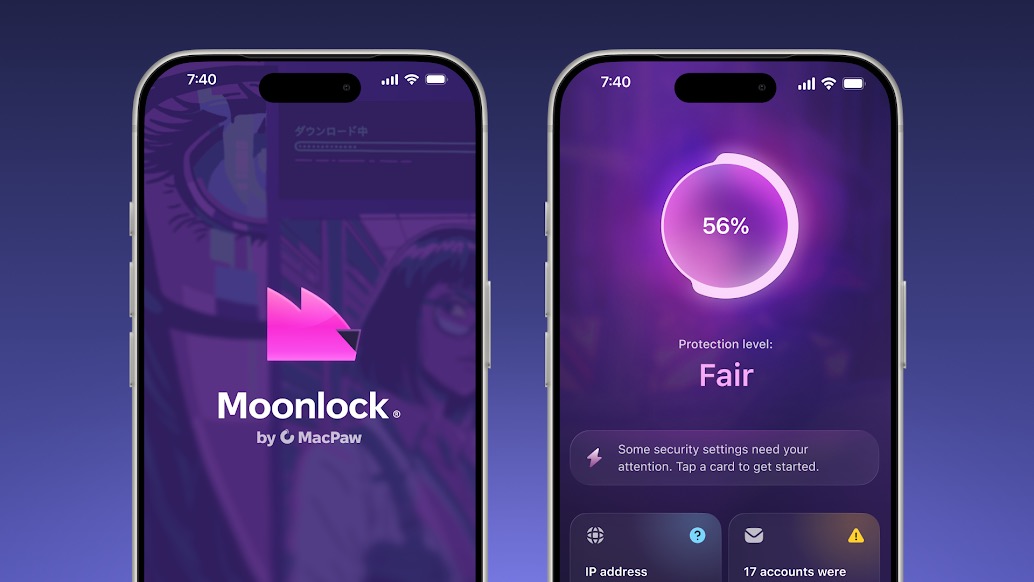
MacPaw today launched its Moonlock cybersecurity app for the iPhone, bringing the company's consumer-focused security features to mobile for the first time.


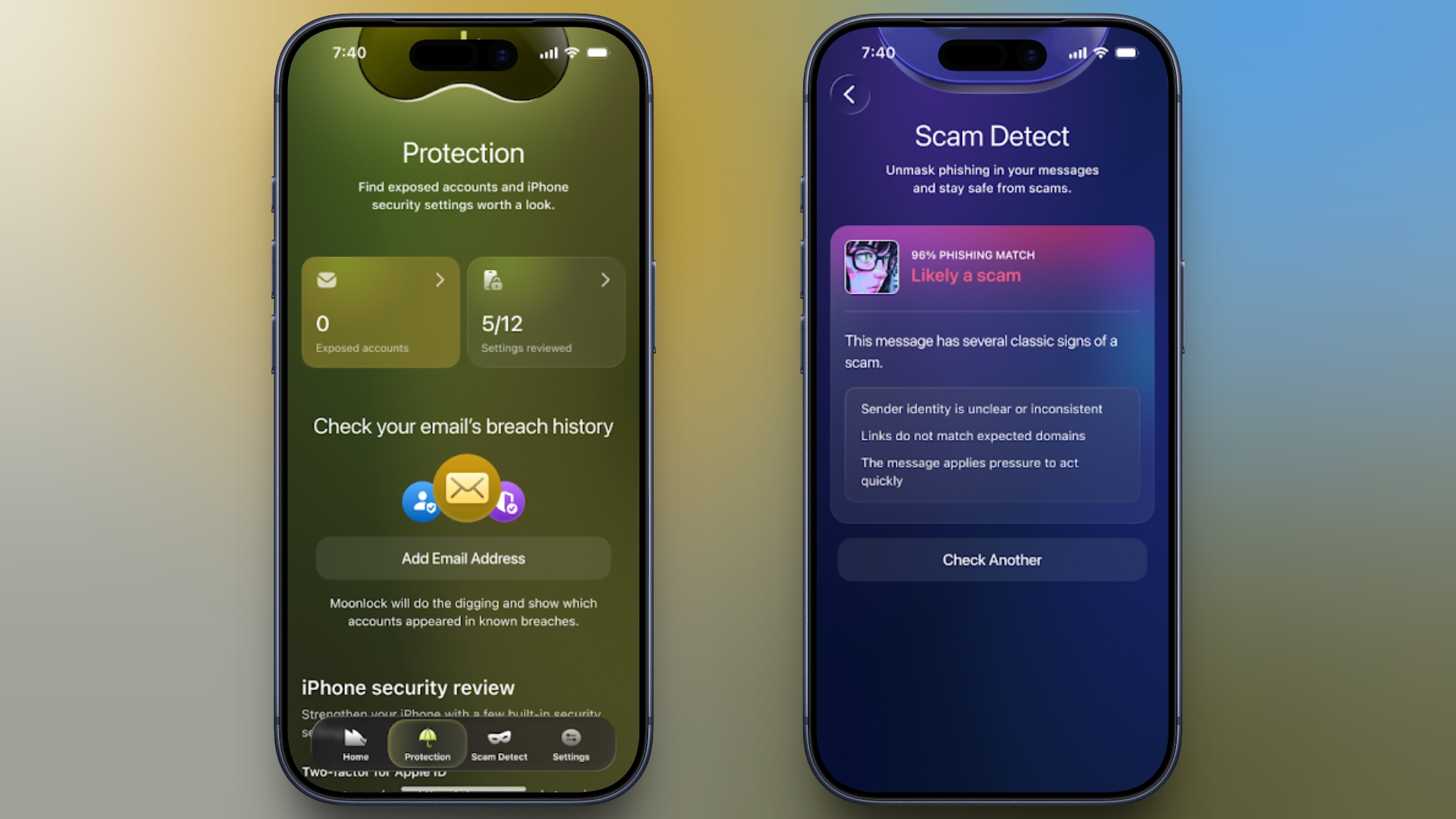
Moonlock is designed to help iPhone users recognize and avoid phishing scams and other online threats, according to the company. For example, one of its key features is Scam Detect, which can check suspicious messages and their contents – like screenshots, links, and QR codes – for signs of phishing.

Users just paste, scan, or share the content directly with Scam Detect, and the Moonlock app will analyze it and provide an assessment explaining why it may be suspicious.

Moonlock includes a number of other security features specific to the iPhone. Safe SMS is an opt-in feature that automatically filters out scam texts, with a record of what was caught and why. Meanwhile, Security Score provides a score from 0 to 100 that reflects the iPhone's security setup, and gives users recommendations on how they can improve it.

With Email Breach History, users can check whether their email address has turned up in a data breach. If so, the feature can reveal the source of the breach, when and what was exposed, and then walk the user through the steps required to secure each affected account.

Moonlock also includes a number of device and network checks, and the app aims to help users review things like their Wi-Fi security, passcode protection, iOS updates, and more, with checklists of recommended one-time actions and step-by-step instructions.

"When we launched Moonlock, our goal was to make cybersecurity something anyone could understand and use. But so much of what people do today, from banking to everyday conversations, happens on their phones. Bringing Moonlock to iPhone felt like the natural next step. We want to help people spot a scam before they tap, see where their security stands, and know exactly what to do next," said Oleg Stukalenko, head of product management at Moonlock by MacPaw.
Moonlock is available to download from the App Store or via Setapp, MacPaw's third-party app marketplace.

Moonlock is offered based on a customizable monthly plan with different rates depending on the number of devices covered. For example, a single-device plan costs $13.50 per month, with yearly billing working out at $4.50 per month. Each plan also has a one-time purchase option. With a Setapp subscription, Moonlock is included for both Mac and iPhone, so no separate iPhone purchase or additional account is required.
This article, "MacPaw's Moonlock Cybersecurity App Launches for iPhone" first appeared on MacRumors.com

Discuss this article in our forums

  •  

Apple Blames Internal Update for Outage, Says It Wasn't a Cyberattack

Apple has largely resolved outages affecting iCloud accounts, retail stores, and more, the company said in a statement to Bloomberg. Apple said the outages were due to an unspecified "internal update" and were not caused by a cyberattack. The company is working to get remaining systems online "as soon as possible."


Issues started around 11:45 a.m. ET, with social media reports suggesting users were unable to access their Apple Accounts or sign in to services. Apple retail store systems were also offline, and customers in stores were not able to complete purchases.

The System Status page is still listing issues with ‌iCloud‌ Accounts and Sign In, AppleCare on Device, Apple Business, Apple School Manager, Schoolwork, ‌iCloud‌ Mail, and ‌iCloud‌ Web Apps. Services are listed as slow or unavailable.

The Apple outage follows other major outages over the last few days that caused an FAA nationwide ground stop and impacted Microsoft 365 services worldwide.
This article, "Apple Blames Internal Update for Outage, Says It Wasn't a Cyberattack" first appeared on MacRumors.com

Discuss this article in our forums

  •  

Apple Accounts, App Store and Apple Music Experiencing Issues

Apple Accounts and iCloud sign-ins appear to be experiencing issues, according to multiple social media reports and Apple's System Status page.


Apple says ‌iCloud‌ Account and Sign In may be slow or experiencing issues, but there are no other outages listed on the site.

There are also reports on social media about Apple retail stores and other services like Apple Music and Apple Pay experiencing issues. Anything related to an Apple Account seems to be malfunctioning, with users unable to sign in.

Update 1:10 p.m. ET: Apple's System Status page is listing outages for App Store, ‌Apple Music‌, and AppleCare on Device, along with the ‌iCloud‌ account issue.

The developer status page lists outages for Accounts, ‌App Store‌ Connect, the ‌Apple Music‌ API, ‌Apple Music‌ Connect, and Apple Podcasts Connect.
This article, "Apple Accounts, App Store and Apple Music Experiencing Issues" first appeared on MacRumors.com

Discuss this article in our forums

  •  

Apple Plans to Release These 18 New Products Next Year

Following a jam-packed couple of months in which it unveiled the iPhone Duo, HomeView, MacBook Pro with PROLED XDR display, and so much more, Apple has likely cleared through its slate of remaining major product announcements this year.


As always, the holiday season should be a relatively quiet time for Apple, and then things will pick back up again in 2027. Already, the company is expected to release at least 18 new products next year, including 20th-anniversary iPhone 20 Pro and iPhone 20 Pro Max models, all-new smart glasses, a larger HomeView, AirPods Pro with cameras, and more.

Below, we have outlined new Apple products that are rumored to launch in 2027, according to Bloomberg's Mark Gurman and rumors from other sources.

iPhone


  • iPhone 18e: A20 chip, 9GB of RAM, and longer battery life.

  • iPhone 18: A20 chip, 9GB of RAM, and longer battery life.

  • iPhone Air 2: A20 Pro chip, Ultra Wide camera, a smaller Dynamic Island, longer battery life, and Apple's C2 modem with mmWave support in the U.S. and "meaningfully faster" upload speeds compared to the current model's C1X modem.

  • iPhone 20 Pro: A21 Pro chip and new design with "curved glass around all corners and edges" and thinner bezels around the screen.

  • iPhone 20 Pro Max: A21 Pro chip and new design with "curved glass around all corners and edges" and thinner bezels around the screen.

  • iPhone Duo 2: Face ID has apparently been tested, but it is unclear if the feature will be finalized in time for the iPhone Duo 2. And based on a recent rumor, the Camera Control button could eventually double as an Action button.


iPad


  • iPad Pro: M6 chip or M7 chip and a vapor chamber cooling system.

  • iPad Air: M5 chip, OLED display, thinner and lighter design, and potentially the Acoustic Display feature that debuted on the iPad mini.

  • iPad: A19 chip with Apple Intelligence support, N1 chip with Wi-Fi 7 support, and Apple's power-efficient C1X modem in cellular models.


Apple Watch


  • Apple Watch Series 13: A leaker claimed the Apple Watch will be receiving a major redesign next year, and this will apparently include a new way of attaching bands. If so, the Apple Watch Series 13 could have significant changes.

  • Apple Watch Ultra 5: While an Apple Watch Ultra 5 has yet to be firmly rumored, a new Ultra model has arrived in four out of the past five years.


Mac


  • MacBook Neo: A19 Pro chip, 12GB of RAM, and potentially new color options.

  • MacBook Air: M6 chip.

  • MacBook Pro: An updated 14-inch MacBook Pro base model with an M7 chip and potentially a Dynamic Island and an illuminated Apple logo.

  • MacBook Pro (PROLED XDR): M7 Pro and M7 Max chips.


Other


  • AirPods Pro: Built-in cameras for Siri AI and Visual Intelligence.

  • Apple Glasses: iPhone-connected smart glasses with cameras, microphones, and speakers. Software features: Siri AI, Visual Intelligence, calling and messaging, notification announcements, music playback, and more. Apple is apparently targeting a WWDC 2027 unveiling and late 2027 availability.

  • HomeView Max: A larger HomeView with a 9-inch screen that can swivel a full 360 degrees on a robotic arm. In the U.S., pricing may start at $999.

Of course, these are only the products rumored so far, with 2027 likely to have more in store.
This article, "Apple Plans to Release These 18 New Products Next Year" first appeared on MacRumors.com

Discuss this article in our forums

  •  

Apple Launches Spanish Version of Its U.S. Website

Starting today, Apple is making its U.S. website available in Spanish. Customers who have Spanish set as their language will be able to browse apple.com/us-es by default, and anyone will be able to choose Spanish from the country and language selector at the bottom of the website.


While most of the site will be available in Spanish, the Apple Online Store and Financial Services will be in English only. Customers who visit the Apple Online Store can shop in Spanish by contacting an Apple Specialist by phone.

There's already a U.S. Spanish version of the Apple Support site, so the change to the main website brings it in line with support options.
This article, "Apple Launches Spanish Version of Its U.S. Website" first appeared on MacRumors.com

Discuss this article in our forums

  •  

Apple Seeks 200,000 People for AI Health Study

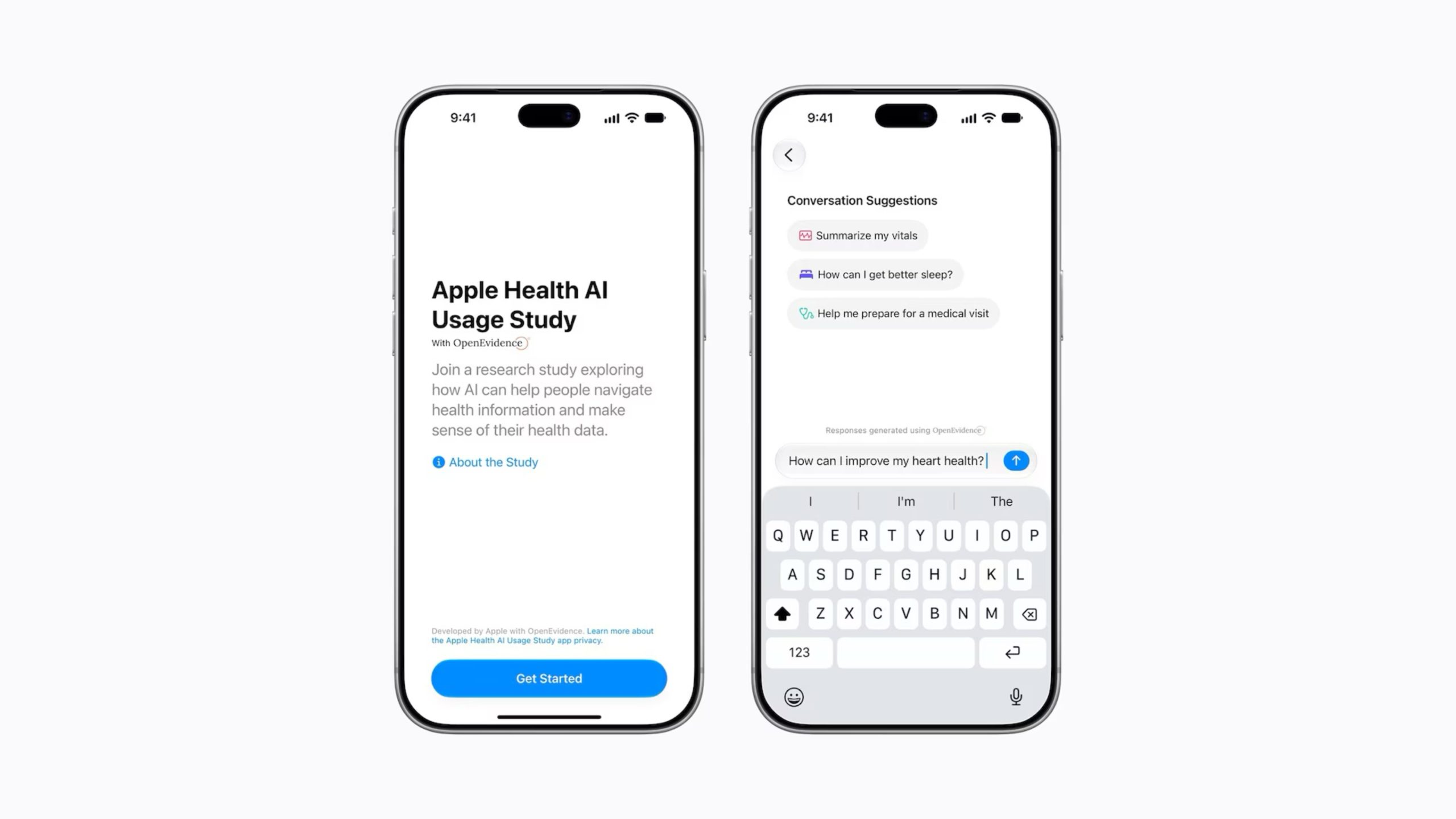
Apple on Sunday announced the launch of an Apple Health AI Usage Study that gives participants access to a dedicated iPhone app that answers everyday health questions using medical research and, optionally, their own Health app data.


Conducted in collaboration with clinical AI company OpenEvidence, the U.S.-only study will examine how people understand and evaluate AI-generated health information, what makes them trust it, and whether it can help them prepare for appointments with their doctors.
"At Apple, we believe responsible innovation starts with scientific rigor and clinical grounding. Health is deeply personal, and conducting a dedicated research study is the most thoughtful way to understand how people engage with, comprehend, and evaluate health AI in everyday life," said Sumbul Desai, M.D., Apple's vice president of Health and Fitness. "Insights from this study will help advance the broader scientific conversation and ensure that as technology evolves, we continue building trusted tools that genuinely support people wherever they are on their health journey."
The app combines OpenEvidence's technology with an Apple-designed research experience, where responses include links to peer-reviewed clinical sources, with information drawn from publications like The New England Journal of Medicine, JAMA, and Nature. Apple says the app presents complex medical information in approachable language.


Participants can choose to share data such as their resting heart rate, activity, sleep, and lab results through HealthKit. The idea is for it to allow researchers to explore whether incorporating personal health information makes answers more relevant and easier to understand. Apple says the app can also help users put Health data in context, understand symptoms or conditions, and build personalized exercise or meal plans.

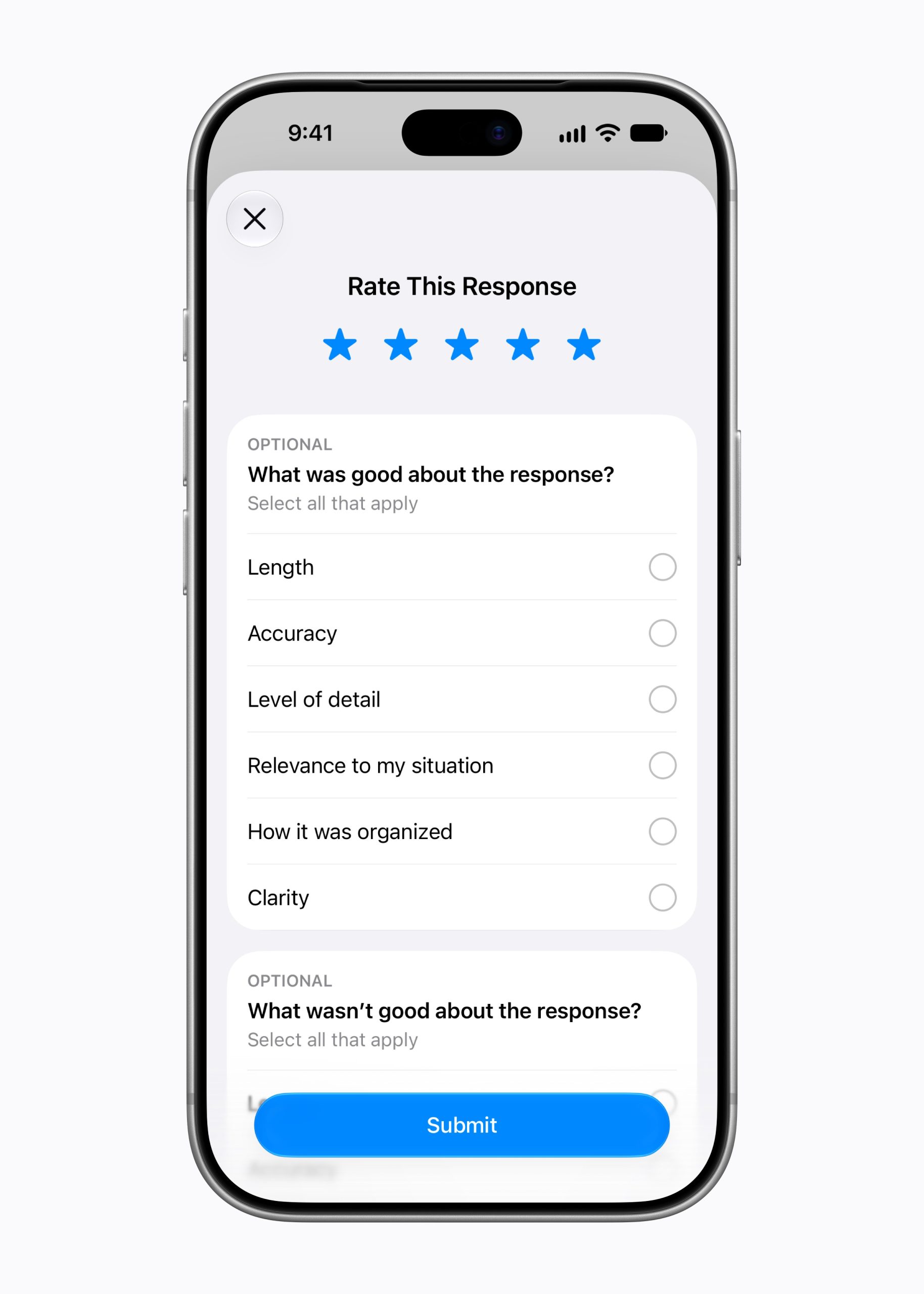
Users can rate responses and complete occasional surveys about their experience, and all questions undergo processing designed to remove identifying information before reaching OpenEvidence, which deletes question-and-response data within 24 hours. Apple says study data will not be used to train AI models, and participants control whether they share HealthKit metrics or survey responses.
"Patients and clinicians are both turning to AI, but the tools they use are being built and tested in separate worlds," said Robert M. Wachter, M.D., UCSF's professor and chair of the Department of Medicine. "When patients and doctors draw on versions of the same trustworthy tools, patients arrive prepared, conversations improve, and next steps happen seamlessly. Connecting these tools, and rigorously studying what works, is how we'll get there."
Apple is keen to stress that health tools powered by large language models can give incomplete or unclear answers, and the app includes safeguards that are meant to detect certain concerning questions and direct users toward a healthcare provider or other resources. The study isn't intended to diagnose or treat conditions, or replace advice from medical professionals.


The study is open to up to 200,000 eligible U.S. residents aged 21 and older with an Apple Intelligence-enabled iPhone running iOS 26 or later. If you're eligible and interested, download the Apple Health AI Study App from the App Store to learn more.
This article, "Apple Seeks 200,000 People for AI Health Study" first appeared on MacRumors.com

Discuss this article in our forums

  •  

Apple Launches Two Products Today

Apple is releasing two new products today, Friday, November 13: the all-new Apple HomeView and the fourth-generation Apple TV 4K, both of which have been available to pre-order since mid-October.

  • Apple HomeView: Apple's new smart home display, powered by Apple Intelligence with Siri AI, for entertainment and managing the home. Available in tabletop and wall-mounted models, it can recognize up to six users by face, each with a personalized Home Screen. The HomeView is priced at $299.

  • Apple TV 4K: adds Siri AI, the A19 chip, an updated Siri Remote with Find My, and support for four-speaker surround sound with HomePod mini 2. The Apple TV 4K comes with 128GB of storage and is priced at $299.
Both products were announced on October 13 alongside the HomePod mini 2, which launched October 30.

As things stand, HomeView is not sold in the European Union because Siri AI is currently unavailable on iOS in the region due to regulatory constraints. Apple has said it is "working constructively with the EU in an attempt to find a path forward," but has provided no timeline for EU availability.
This article, "Apple Launches Two Products Today" first appeared on MacRumors.com

Discuss this article in our forums

  •  

Apple Support Community Deserved a Proper Goodbye

Apple on Tuesday abruptly placed the Apple Support Community into a read-only state and announced that the forums will be permanently closing on Friday, November 20. Those who contributed to the site — some for more than two decades — were blindsided by this decision and had no chance to post farewell messages.

Even if you felt the Apple Support Community contained too many generic or unhelpful answers from users trying to boost their post counts and earn points, the people volunteering their time to the site still deserved a proper goodbye.

Below, we have highlighted some of those people and their experiences.

Jeff Donald from Florida was a member of the Apple Support Community since November 2000, when the forums were still known as Apple Discussions. This past year, Apple recognized his efforts by inviting him to the Apple Community+ program, which launched in 2022 and provided members with a few extra perks and experiences.

Leroy Douglas was a member since July 2009. He said he was a bit shocked to see Apple's sudden announcement, but he saw the writing on the wall.

Here is a fun fact that you might not have known: In addition to English, Tobias Steen in Germany said there were also Apple Support Communities in Chinese, French, German, Japanese, Korean, Portuguese, and Spanish. For some reason, the French and German versions do not have closure notices, but we are told they will meet the same fate.

The forums brought together people of all ages, from 16-year-old Evan Bato Rousseau in France to 83-year-old Nobel Prize winner Sir Tim Hunt in England, who told us he found it to be a helpful resource, even if some of the answers were wonky.

John Daniel, the Canadian developer of macOS diagnostic tool EtreCheck, said he was active in the Apple Support Community for more than two decades. Users like him who reached "Level 6" or higher based on their contributions received access to The Lounge, a private category of forums where Apple employees sometimes participated.

Prior to 2020, John said Apple occasionally hosted in-person meetups for Support Community members, including a special visit to Apple Park.

"I don't agree with comments that so many are making about the Apple Support Community right now," he said, in response to those who described it as useless. "We regularly solved problems, identified significant issues with Apple projects, traced the cause of bugs and fixed them, and always learned new things. That's what I'm going to miss."

Elías Rojano Núñez of Chile participated in the Spanish forums. He told us that he found it deeply satisfying when he was able to help others, and he was saddened that the Spanish forums were shuttered without any advanced notice, but he is grateful for the opportunity that he had and will always value the interactions he had with fellow contributors.

Rojano Núñez shared a photo of some of the items he received from Apple over the years, including a 5-year Apple Support Community anniversary pin. There were also 10-year, 15-year, and 20-year pins. Over the years, merchandise given out included Apple-branded hats, shirts, tote bags, and even umbrellas once.


Whatever its shortcomings, the Apple Support Community was more than just a place to ask questions. For some, it was a place to belong.

To that, we say goodbye and thank you, not good riddance.
This article, "Apple Support Community Deserved a Proper Goodbye" first appeared on MacRumors.com

Discuss this article in our forums

  •  

Apple's Claris Testing 'Harbor' App for Local AI on Macs

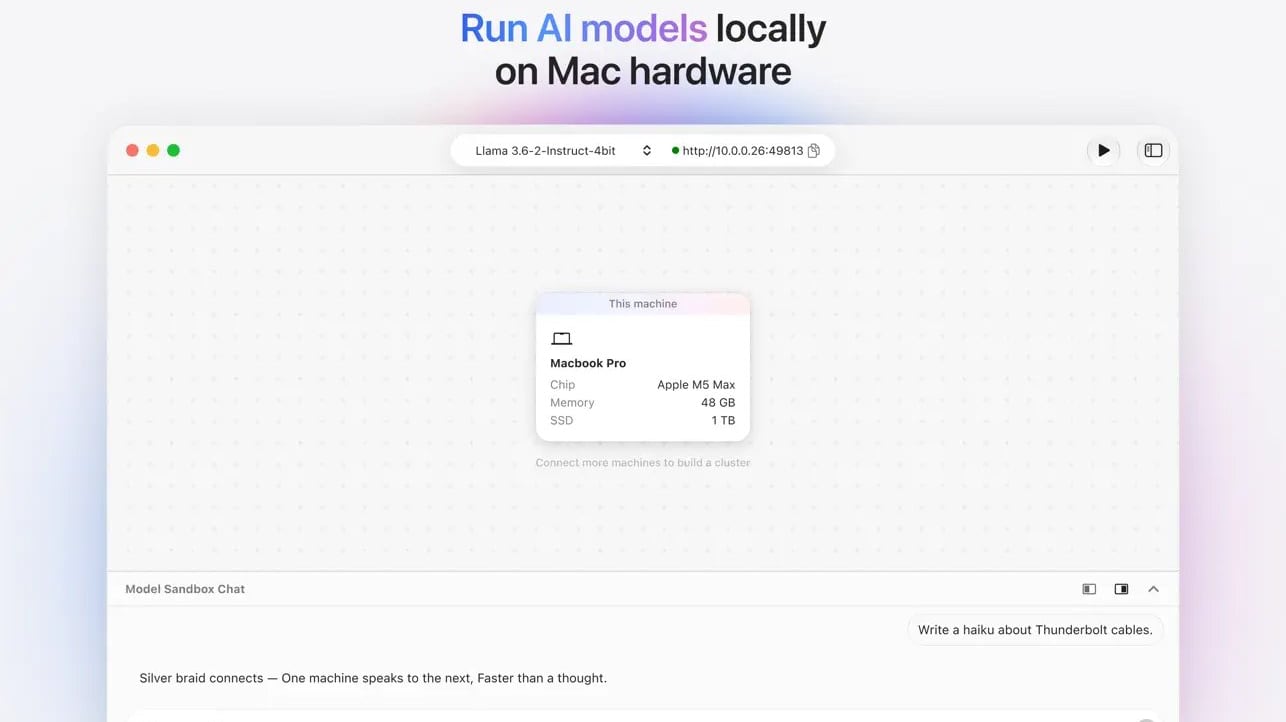
Apple's Claris subsidiary is testing an app called Harbor, which turns Apple silicon Macs into a private AI server.


Harbor works with a single Apple silicon Mac, but it also supports connecting multiple Mac computers over Thunderbolt 5 to pool unified memory for larger models. Apple added RDMA over Thunderbolt 5 with macOS Tahoe 26.2, making clustering faster.

Harbor detects devices connected over Thunderbolt 5 and lets users browse for, download, and load open-weight models. It's described as an easy-to-use app with no manual configuration required.
Harbor turns your Mac into a private AI inference server. Run open-weight models locally on Apple silicon—your data never leaves your hardware, and nothing reaches the cloud. Connect multiple Mac computers over Thunderbolt 5 to pool unified memory, enabling large models and higher concurrency than a single computer can handle alone.

Set up in minutes, not hours. Harbor automatically detects your devices over Thunderbolt 5 to form a cluster. Plug in, start, and you're running—no manual configuration, no command line, no infrastructure expertise required.


Download and run models directly. Browse, download, and load open-weight models from within the app. Harbor handles model management so you can focus on the work, not the setup.

Cluster for scale. Connect two or more Thunderbolt 5-capable Mac computers and Harbor pools their unified memory into a single inference resource. Run models that exceed any single computer's capacity, or serve more concurrent requests across your cluster.

Harbor is in early access and is not publicly available. There was an App Store listing, but it has now been removed.

Claris is known for its database platform FileMaker, which is aimed at businesses, so it isn't clear how Apple will market the Harbor app or whether it will be free. The sign-up page for Harbor asks for a company name, which suggests more of a business focus.

There are already well-known, free alternatives for Mac users who want to run a local AI server. Exo is an open-source tool for clustering Macs, and LM Studio is available for single-Mac use, but Apple's Harbor app appears to combine LM Studio's simple interface with clustering.
This article, "Apple's Claris Testing 'Harbor' App for Local AI on Macs" first appeared on MacRumors.com

Discuss this article in our forums

  •  

Apple Launching Two More New Products This Friday

The Apple launches keep coming! The company is set to release two new products on Friday, November 13: the all-new Apple HomeView and the fourth-generation Apple TV 4K, both of which have been available to pre-order since mid-October.

  • Apple HomeView: Apple's new smart home display, powered by Apple Intelligence with Siri AI, for entertainment and managing the home. Available in tabletop and wall-mounted models, it can recognize up to six users by face, each with a personalized Home Screen. The HomeView is priced at $299.

  • Apple TV 4K: adds Siri AI, the A19 chip, an updated Siri Remote with Find My, and support for four-speaker surround sound with HomePod mini 2. The Apple TV 4K comes with 128GB of storage and is priced at $299.
Both products were announced on October 13 alongside the HomePod mini 2, which launched October 30.

As things stand, HomeView will not be sold in the European Union because Siri AI is currently unavailable on iOS in the region due to regulatory constraints. Apple has said it is "working constructively with the EU in an attempt to find a path forward," but has provided no timeline for EU availability.
This article, "Apple Launching Two More New Products This Friday" first appeared on MacRumors.com

Discuss this article in our forums

  •  

Bristol – digitale Zeichnungen mit analogem Touch

04. November 2026 um 10:18

Bristol reproduces the way people draw on paper. It does not “imitate paper”, and it does not win on features. Each tool is a layer, and Bristol offers little help when it comes to sketching. One undo, no redo. No hiding of layers, no cut and paste. No selection, no fill, no fancy drawing tools. You sketch, you erase. Bring your pencil, ink, and markers, and that’s pretty much it. Ok, it has highlights. And a draft paper. And a reference image. But that’s pretty much it.

kornclub.io

Bristol ist das persönliche Projekt von Ulysses-Mitbegründer Marcus Fehn, charmant meinungsstark und viel zu preiswert.

Im Fokus steht, was nicht geht: Anstelle bei der Werkzeugauswahl zu prokrastinieren, setzt euch die iPad-App vor ein (warm-)weißes Blatt – zumindest weitgehend. Die Konturen aus einem Referenzfoto könnt ihr nachzeichnen; bei der Konstruktion von (Comic-)Panels oder der Findung von Fluchtpunkten lasst ihr euch unter die Arme greifen.

Ansonsten zeichnet und skizziert ihr aus freier Hand – sehr analog. Bristol ist Software, für die man sich ein iPad kauft.

  •  

Tipp: Multitasking in iPadOS 27.2

30. Oktober 2026 um 10:16

➝ YouTube

Die Funktion „Double-Tap Top of Window to Zoom“ ist per se nicht neu, lässt sich durch den Button jetzt aber explizit aktiven beziehungsweise deaktivieren.

Außerdem im Video: eine Änderung für „Side-by-side Multitasking“ sowie dieser Shortcut.

💾

  •  

„Apple gives iPad mini its biggest update ever“

26. Oktober 2026 um 14:15
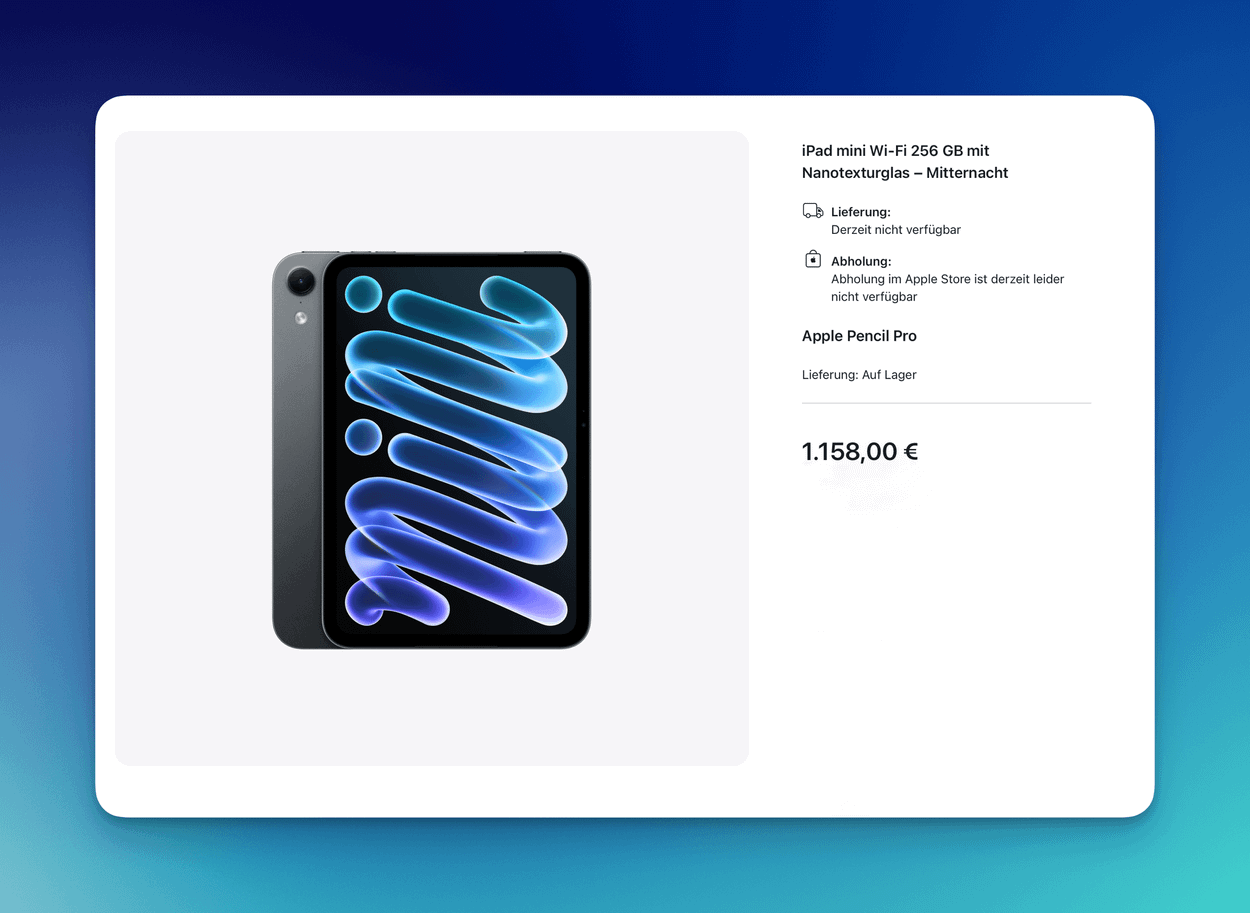
Product page showing an iPad mini Wi-Fi 256 GB with Nanotexture Glass in a dark color, displayed on the left. On the right, the product details and price of 1,158.00 euros are visible, along with availability notes regarding delivery and in-store pickup.

Featuring a stunning OLED display in an even thinner and lighter design, a huge leap in performance, faster wireless connectivity, and water and dust resistance.

Apple.com/Newsroom

Wenn nicht iPhone draufsteht, kostet es lediglich die Hälfte.

  •  

Zuverlässiger Fernzugriff: Jump Desktop in Version 10

19. Oktober 2026 um 20:55
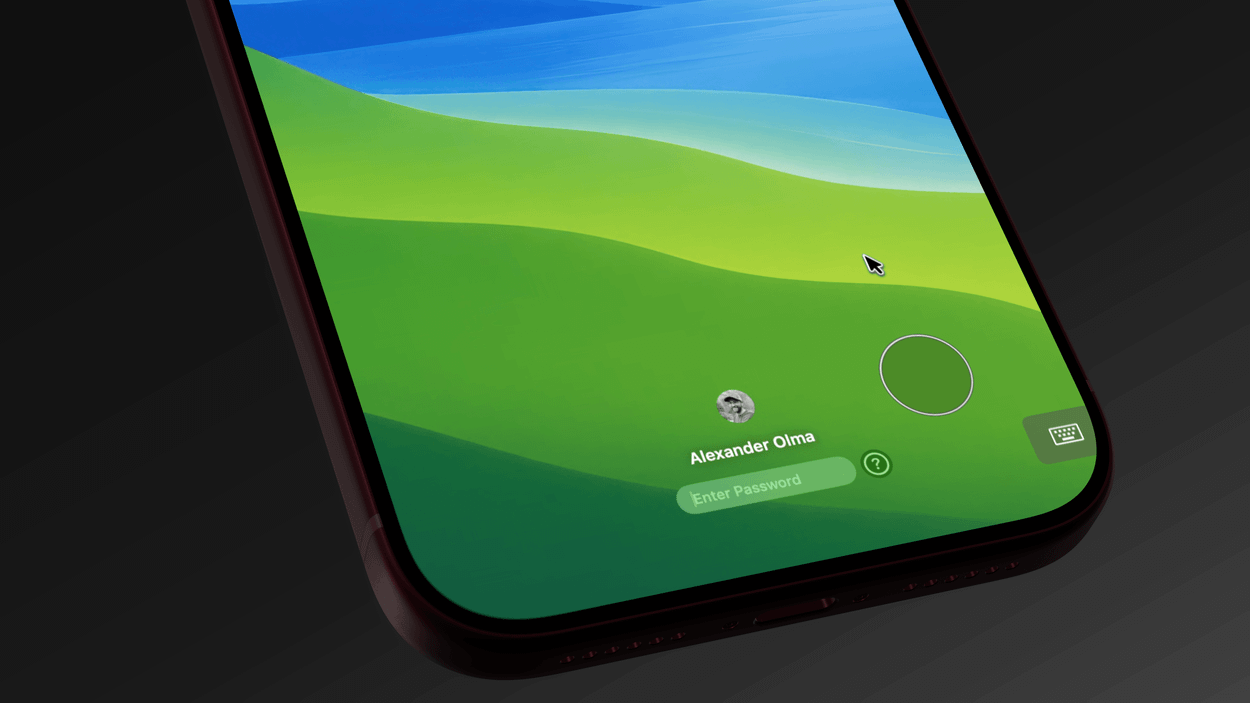
Close-up of a smartphone displaying a login screen with abstract green and blue background. The login prompt shows a user icon and the name Alexander Olma, along with a password entry field and icons for help and keyboard.

The best remote session is the one you forget is remote. Jump Desktop Version 10 is like sitting down at the machine itself and bringing the devices on your desk with you. It also goes where it couldn’t before. We’re releasing a native app for Android phones and tablets, Linux computers can be hosts, and with Jump CLI your scripts and AI agents can connect too. Here’s what’s new:

Jump Desktop Documentation

Seit Sommer bin ich täglicher Fan – und verschlief trotzdem den offiziellen Release von Version 10 vor einem Monat, weil ich auf der TestFlight-Beta rumhing.

  •  

#527 – so entsteht ein „Kalenderwochen“-Podcast

15. Oktober 2026 um 15:31

Es hat ernsthaft eine Minute gebraucht, bis ich (m)einen Workflow für den neuen Podcast zusammengesteckt hatte. Und das wird wahrscheinlich erst der Anfang sein …

Was ich derzeit am Set-up mag: Es funktioniert weitgehend auch von unterwegs aus und ist sowohl flexibel als auch automatisiert genug.

Hier das Intro der Episode:

Weiterlesen

  •  

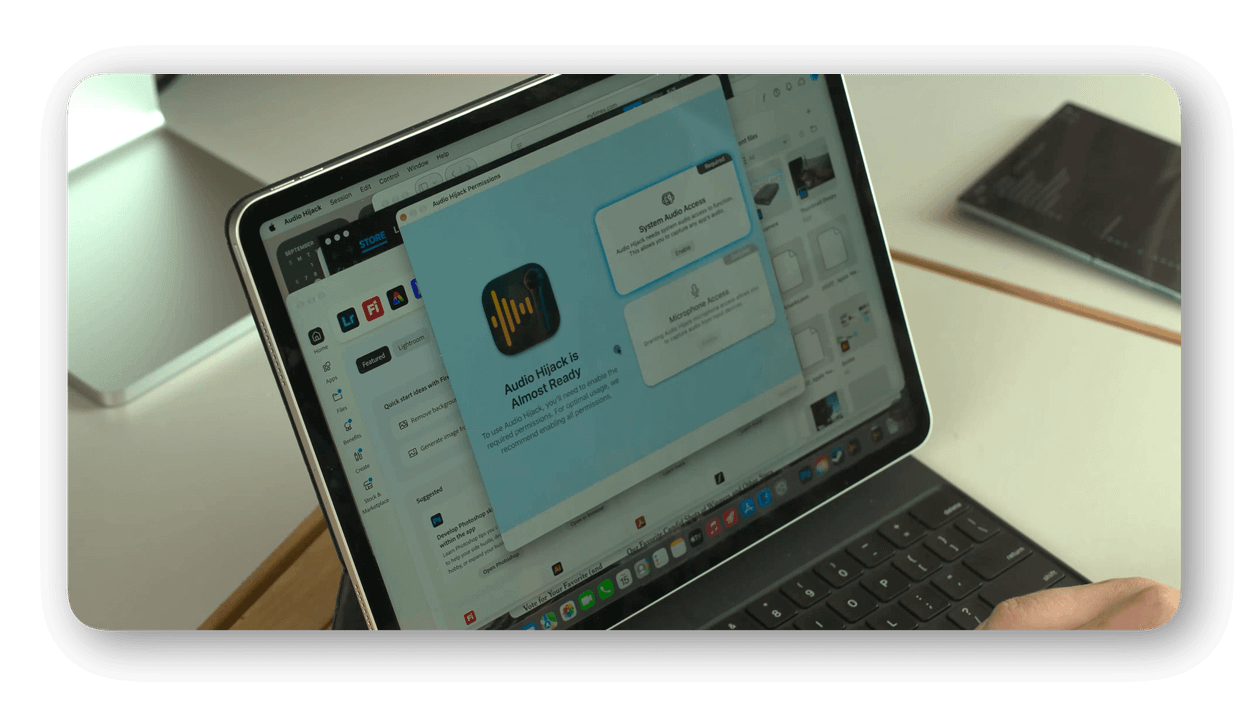
„My iPad Runs Steam Now“

03. Oktober 2026 um 12:40
A close-up of a laptop screen showing a permission popup for 'Audio Hijack' software, asking for system audio and microphone access. The laptop is placed on a desk with a hand visible on the keyboard, and a tablet is seen in the background.

„My iPad Runs Steam Now“ ist nur einer von mehreren interessanten Aufhängern1 dieses sorgfältig recherchierten Videos von Quinn Nelson. Und ich stimme ihm zu: macOS in einer virtuellen Maschine auf dem iPad war vor einigen Jahren mal verlockend; inzwischen will man dort schlicht und direkt Mac-Apps benutzen.

Mit einem Fernzugriff läuft macOS nämlich bereits in einem Fenster von iPadOS. Heute fehlt dem iPad der bunte Blumenstrauß von Software, die gerade auf macOS entsteht – selbstgeschriebene Apps und KI-Agenten, die sich in die (hervorragenden und weitreichenden) Bedienungshilfen hängen.

Speziell stolpert Software bei der Distribution über den App Store. Dieser Vertriebsweg erscheint mit Blick auf persönliche Software veraltet – nicht nur sein Prüfprozess, sondern insgesamt der Aufwand, um Software zu teilen.

Native Apps waren Web-Apps seit nunmehr 20 Jahren überlegen. Mit personalisierter Software nähern wir uns jedoch einem Punkt, an dem ich lieber meine selbstgehosteten Apps und Skripte im privaten Tailscale-Netzwerk über den Browser öffne. Ich bekomme sie nicht nur schwierig in den App Store, sondern ich will sie dort überhaupt nicht veröffentlichen. Es ist Software für mich und iOS/iPadOS scheinen auf diese Zukunft nicht vorbereitet.

  1. Seine Jailbreak-Exkursion wäre ein eigenes Video wert. „Er ist tot, Jim!“ ↩
  •  

PageFeed – RSS-Feeds durchgeblättert

03. September 2026 um 21:47
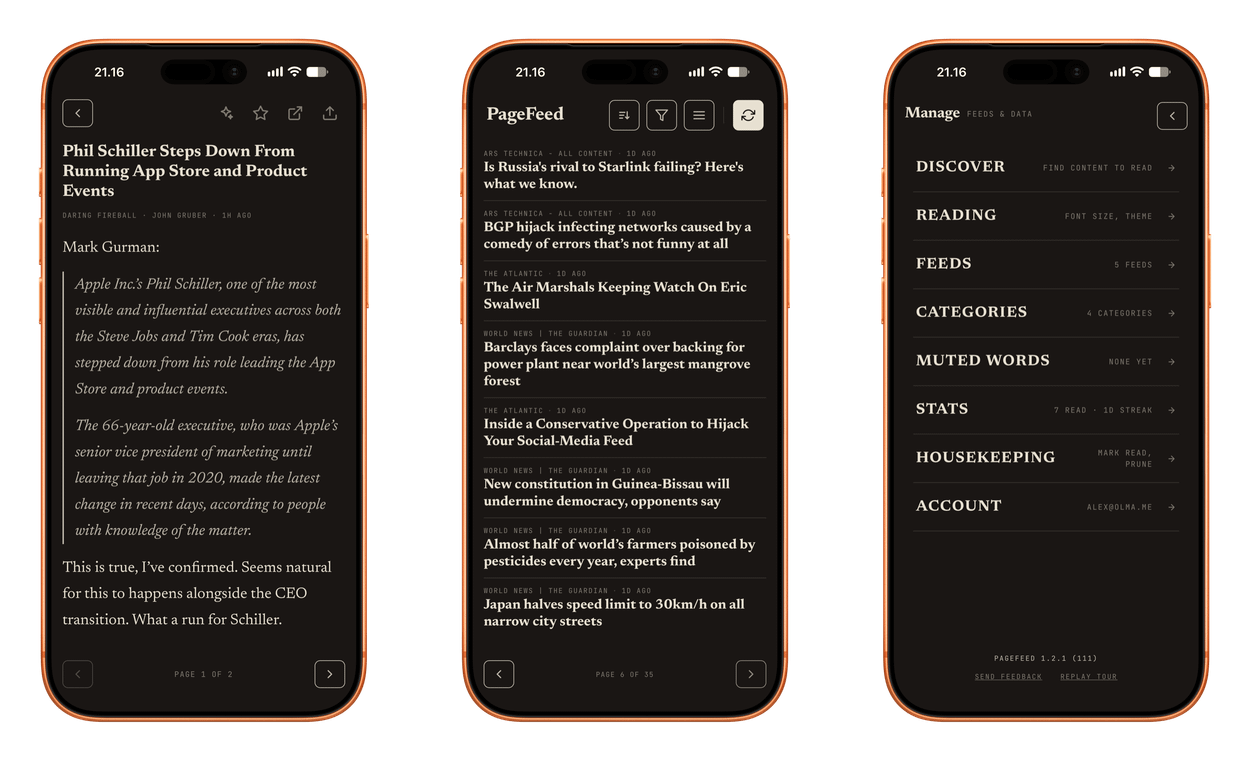
Three screens from the PageFeed mobile application showing an article view, a news feed, and the manage settings menu.

No endless scroll. No algorithm deciding what you see. Just the writers you choose — turned page by page, the way a newspaper used to feel.

PageFeed

Nichts für berufliche RSS-Leser:innen, aber ein erfrischender Take für die Kategorie der Feed-Reader.

Ihr wollt hier explizit nur wenige Quellen eintragen, von denen ihr dann aber keinen Eintrag übersehen möchtet – „Calm Feeds“, etwa für einen entspannten Sonntagvormittag.

Statt TikTok-Scrolling tippt ihr fürs Umblättern hier wie am Kindle. In die meinungsstarke Aufmachung lässt sich kaum reinquatschen: Lediglich zwischen unterschiedlichen Schriftgrößen sowie einem E-Ink-Mode wählt ihr aus. Das nenne ich Mut zur Entscheidung!

Der Sync verläuft nicht nur zwischen euren iPhones und iPads, sondern reicht bis ins Web – bereits die kostenlose Version ist viel zu großzügig. Mit nur wenigen Euro schaltet ihr alle anderen Nettigkeiten frei.

PageFeed fühlt sich wie eine typische Später-Lesen-Anwendung an, bleibt aber ein Feed-Reader – eine liebevolle Verpackung von RSS-Abos.

  •  
❌